



A circuit breaker trips when a circuit draws more current than it should. That’s usually down to an overload, a short circuit, a faulty appliance, a worn breaker or a fault in the wiring. One trip after several appliances start at once is often an overload. A breaker that trips again straight after one reset, or trips with very little running, needs a licensed electrician.
Picture it: the air con is running, the microwave is reheating dinner, you start the dishwasher and the kitchen goes dark. Again. If your circuit breakers keep tripping, your electrical system is telling you something is wrong, and it’s worth finding out what.
Before you go any further, check which device has tripped at the switchboard:
- A circuit breaker trips when an electrical circuit draws too much current, from an overload or a short circuit. It protects the wiring.
- A safety switch, also called an RCD, trips when it detects electricity leaking to earth, which can happen before someone gets a shock. It protects people. Safety switches usually have a test button, and standard circuit breakers don’t. Some devices combine both jobs.
If you’re not sure which is which, read the difference between a safety switch and a circuit breaker. If the device that tripped has a test button and trips with nothing plugged in, see our guide on a safety switch that keeps tripping with nothing plugged in.
Here are the six likely culprits for homes across Newcastle, Lake Macquarie and the Hunter, and when to call a licensed electrician.
1. Your Circuit Is Overloaded: You’re Asking Too Much of It
Your electrical circuit is a bit like a buffet plate. Pile too much on and something is going to spill.
If the air conditioner, dryer, dishwasher and microwave are all running at once, they may be asking more of the circuit than it’s designed to supply. An overloaded circuit trips the breaker, which cuts the power so the wiring doesn’t overheat.
How to Fix It:
✓ Turn off or unplug the extra appliances, then try one safe reset: switch the breaker fully off, then back on once.
✓ If it trips again, stop there. Don’t keep resetting it, and call a licensed electrician.
✓ Run heavy appliances at different times rather than all together.
✓ If trips keep happening, a licensed electrician can check whether your home needs extra circuits or a switchboard assessment. Read about a switchboard upgrade in Newcastle.
2. You’ve Got a Short Circuit, and That’s Not Good
A short circuit happens when an active wire touches a neutral or earth conductor. That causes a sudden rush of current, and the breaker trips almost instantly to cut it off.
Signs of a short circuit can include:
- The breaker trips again straight after a reset
- Burn marks or a burning smell near a power point
- A spark or crackle when you plug something in
How to Fix It:
✓ Don’t keep resetting the breaker to test it. Leave that circuit off.
✓ If you see burn marks or a hot or discoloured power point, stop using it and call a licensed electrician. Read what to do when a power point gets hot.
✓ If the smell is coming from the board, read about a burning smell from the switchboard.
Finding a short circuit is licensed work, not a DIY job.
3. Earth Leakage: When Electricity Takes the Wrong Exit
Has the power dropped out when the hot water system or dishwasher was running? It could be earth leakage, where electricity leaks from a circuit and takes an unintended path to earth, often through moisture or metal.
Earth leakage usually trips a safety switch rather than a standard circuit breaker. It’s more likely around wet areas such as kitchens, bathrooms, laundries and outdoor power points, and it’s a shock risk, so take it seriously.
How to Fix It:
✓ If it started during or after wet weather, read about a safety switch tripping after rain.
✓ If the safety switch won’t stay on after one safe reset, read about a safety switch that won’t turn back on and call a licensed electrician.
✓ Don’t keep using a power point or appliance you think is causing it.

4. Certain Appliances Are Just Energy Hogs
Some appliances can trip a breaker, either because they draw a lot of power when the circuit is already loaded, or because the appliance itself has a fault.
Appliances That Can Trip a Breaker:
- Air conditioner: if it trips the breaker as it starts, the circuit or the unit may need checking.
- Microwave: if it cuts the power, the circuit may already be loaded.
- Dryer: a fault in the heating element or motor can trip the breaker.
- Hot water system: an internal fault can cause sudden trips.
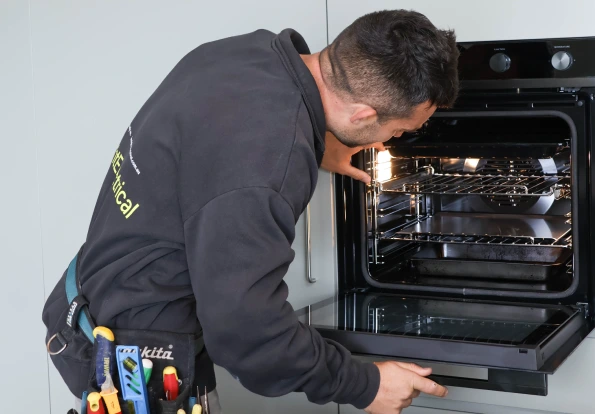
- Oven: a worn element or wiring fault can trip the circuit when it heats up.
How to Fix It:
✓ If it only trips when one appliance starts, leave that appliance off and call a licensed electrician. Don’t move it to another circuit to test it.
✓ A licensed electrician can tell whether the circuit or the appliance is at fault. If it’s the appliance, you may also need an appliance technician.
✓ Keep filters and vents clean, as the manufacturer recommends.
5. Your Circuit Breaker Might Be Faulty
Circuit breakers don’t last forever. A worn or faulty breaker can trip when it shouldn’t, or fail to stay on.
Warning Signs:
✓ It trips again and again with very little running.
✓ There’s a burning smell at the switchboard.
✓ It won’t stay on after one safe reset.
How to Fix It:
✓ Have a licensed electrician inspect the switchboard. Replacing a breaker is licensed work.
✓ If your home still has an old ceramic fuse board, a licensed electrician can assess whether an upgrade makes sense. In older Newcastle homes, some switchboards can be close to their limit with today’s appliances. We only replace switchboards if they pose a significant safety risk due to age or wear. Read about the benefits of a switchboard upgrade.
✓ The main switch turns off power to the whole house. Switching it off and on is not a way to reset a tripped circuit breaker.
6. You’ve Got Wiring Issues, and You Shouldn’t Ignore Them
If your breaker trips often with no obvious overload, the wiring in your home could be the problem.
Signs of a wiring fault can include:
- Flickering lights or buzzing power points
- Breakers tripping with very little running
- Burn marks around power points or a burning smell
How to Fix It:
✓ Don’t ignore electrical faults that keep coming back. Faulty wiring can be a fire risk.
✓ Book an inspection, especially in an older home. See how often to get a home electrical inspection, and for older Hunter homes, read about rewiring an older Newcastle home.
✓ If part of the house has lost power, see why half the house has no power.
When to Call an Electrician Before Things Get Worse
Call a licensed electrician if:
- The breaker trips again after one safe reset
- It trips with very little running
- You notice a burning smell, scorch marks, buzzing or a hot or discoloured power point
- You can’t tell whether a circuit breaker or a safety switch has tripped
- Trips keep coming back
Don’t keep resetting a breaker that won’t hold, and don’t open the switchboard. NSW Government advice is that DIY electrical work is dangerous and illegal, and that unless you’re a qualified electrician you should never “carry out any electrical maintenance other than changing a light globe.” You can read that guidance on the NSW Government page about electrical safety in the home.
A licensed electrician can test the circuits safely, find the fault and repair it. When the work is done, you receive a Certificate of Compliance for Electrical Work (CCEW). Our licensed electricians work across Newcastle, Lake Macquarie and the Hunter from our base in Redhead, with over 40 years of combined experience. Book a residential electrician in Newcastle or see our electrical maintenance in Newcastle. Call us for a free quote. We provide emergency call-out services during operating hours and will always do our best to assist.
Call Insight Electrical, your local Newcastle electrician, on 0468 043 743, Monday to Friday, 7am to 5pm, or contact Insight Electrical online.
Frequently Asked Questions
What’s the difference between a circuit breaker and a safety switch?
A circuit breaker trips when a circuit draws too much current, which protects the wiring. A safety switch trips when it detects electricity leaking to earth, which protects people from electric shock. Safety switches usually have a test button.
Is it safe to keep resetting a circuit breaker that keeps tripping?
No. Unplug the extra appliances and try one safe reset. If the breaker trips again, leave it off and call a licensed electrician.
How do I find what is tripping my circuit breaker?
Don’t try to track it down yourself by switching breakers or plugging appliances back in one at a time. A licensed electrician can test the circuit safely and find the fault.
Is it dangerous if a circuit breaker keeps tripping?
It can be. The breaker is doing its job by cutting the power, but repeated trips can point to an overload, a short circuit or a wiring fault that needs a licensed electrician.
Why does my breaker trip when it rains?
It’s usually a safety switch reacting to earth leakage from moisture in outdoor fittings or wiring, not a circuit breaker. A licensed electrician should find where the water is getting in.
Why does my circuit breaker trip with nothing plugged in?
If nothing is plugged in, the device tripping is often a safety switch, and the cause may be a hardwired appliance or a wiring fault. Call a licensed electrician.
Why does my air conditioner trip the breaker?
An air conditioner can trip the breaker if the circuit is already loaded or the unit has a fault. A licensed electrician can check the circuit, and an air conditioning technician can check the unit.